
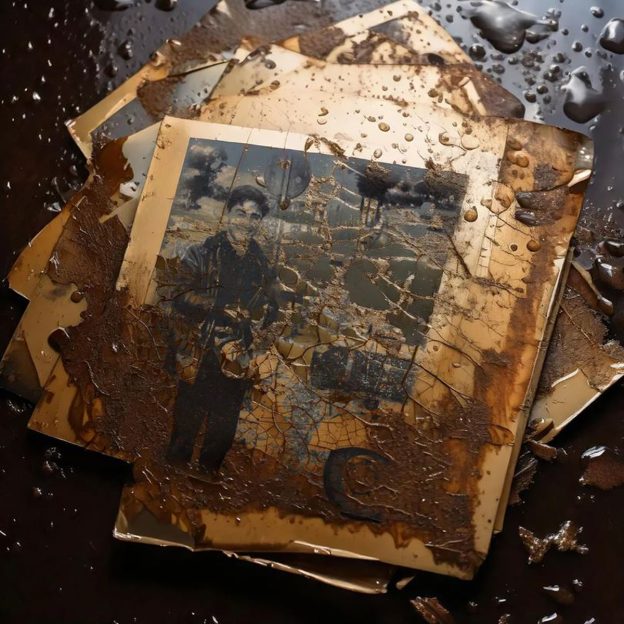
Wondering how to preserve old family photos? Proper photo storage, careful handling, and good recordkeeping can help protect your family’s photographic history for future generations. Professional archivist Sam Rintoul shares six practical dos and don’ts for preserving printed photographs and family archives at home.
Six Expert Tips for Preserving Your Family Photos
Sam Rintoul, professional archivist and founder of Mnemosyne Digital, shares her top six do’s and don’ts when it comes to working with and storing your old family photos!
Do: Keep Brief Records
Take the minute to write the relevant information on the back of the photograph or to add the metadata in the details section of your digital photograph. This does not have to be extensive—keep it short, sweet and to the point. You may know the who, what, when, where and why right now, but what about in 30–50 years? Think about those details for the person who will be inheriting your collection and wishing they knew the names or locations. Future-you will be grateful that past-you took those few moments to jot anything down to provide context and jog those memories.
Do: Check the Quality of Your Storage Materials
Whether you scrapbook, use photograph albums, or store all your photographs in envelopes or boxes, materials matter. Unless the materials are archival quality, the paper used to print, attach or contain the photographs typically contains properties such as lignin, which leads to acidity over time.
Take a piece of paper and tear a piece off anywhere. Those tiny and frayed fibrous edges that you just created? Regardless of what the material was that created the paper, the cellulose in those fibers is what is going to eventually break down into what is known as lignin, which is acidic. Think of newspaper clippings that yellowed with age or became extremely brittle. When you find archival-quality materials that say “lignin free” and “buffered,” it means that the lignin has already been removed and that a protective layer has been added to reduce the pH, reducing the potential for acidity.
Do: Think About How You Handle Photographs
All photographs have emulsion layers. Essentially, an emulsion layer is a thin, light-sensitive layer that captures an image when exposed to light.
If we touch the face of a photograph, the natural oils and salts in our skin can leave residue behind as shiny spots and smudges or cause reactions with the emulsion layer or the backing, which can lead to discoloration, fading and degradation.
Many of you may have older photographs—perhaps even tintypes or daguerreotypes. These have a fragility to them and chemical compositions that modern photographs do not possess.
When handling photographs, regardless of age, if you do not have gloves handy, try to hold them only by the edges or let them rest flat on your hand. If you do wear gloves, nitrile (or similar) gloves are the best choice for photographs. Cotton gloves can impede movement, catch on edges, and transfer loose fibers and dust to the photographs. If you know you will be handling photographs with your bare hands, washing your hands thoroughly beforehand will help remove excess oil.
Don’t: Underestimate Temperature
Do not underestimate the role temperature can play in wreaking havoc on your photograph collection. Take a moment to think about how and where you store your photograph collection.
Many times, photographs are kept in uninsulated attics, basements or storage units where they experience constant swings between extreme temperatures year after year. Heat causes materials to expand, while cold causes them to contract, affecting them on a molecular level. Depending on your climate (and factors such as moisture), this can lead to warping, brittleness, mold and other forms of damage. Keeping photographs in an insulated, temperature-controlled environment provides the greatest long-term stability for your collection.
Don’t: Treat Your Photographs Like Office Supplies
Talk to any archivist and the bane of their existence is photographs and documents that have been taped, stapled, paper-clipped, pinned, stickied, glued, rubber-banded, written on, laminated or otherwise decorated.
Many of these materials eventually cause damage. Metals can rust, affecting the photograph’s emulsion, while tapes and glues are often acidic and leave behind residue when removed.
If scrapbooking is your jam, more power to you! A simple suggestion is to invest in two copies of the photographs you plan to use. That way, one copy remains untouched for long-term preservation while the other can become part of your creative project.
Don’t: Store Photographs on the Ground
Unfortunately, storing boxes of photographs directly on the ground is an all-too-common occurrence.
Long-term moisture absorption, insects, dust and rodents can all damage a collection, but the greatest threat is flooding. Whether caused by a natural disaster or a sprinkler system, standing water can ruin a photographic collection in a very short amount of time. Even storing your collection on a low shelf provides significantly better protection than leaving it on the floor.
Conclusion
Above all, do not forget to have fun and be in the moment. Collecting and preserving family, chosen-family and friends’ memories should be an enjoyable experience.
When it comes to preservation, something is always better than nothing. Any step forward—no matter how small—is still a step in the right direction. So have fun and go preserve some photographs! Just remember: preserving your photographs today is far more cost-effective than conservation and restoration work will be in the future.
Frequently Asked Questions About Preserving Family Photos
What’s the best way to store old family photographs?
The best way to preserve old photographs is to store them in archival-quality, lignin-free, buffered materials in a cool, dry, temperature-controlled environment. Avoid attics, basements and areas with frequent temperature fluctuations.
Should you write on the back of old photographs?
Yes. Recording names, dates, locations and other important details helps preserve the history behind your photographs. Future generations will appreciate having this information, whether it is written on the back of a printed photo or stored as metadata in a digital image.
How should you handle old photographs?
Handle photographs by their edges whenever possible. Clean hands are usually sufficient, although nitrile gloves are recommended for especially delicate or historic photographs.
More About Sam
“My path to becoming an archivist began back in 2011 when I volunteered in the Archives at my local community college for a research project and I was hooked. I have always loved history but for me, it is the personal touches and imagining the life connected to that item that drew me in and fed the love. When standing in the Archives, instead of just reading about history on the pages of books, I could touch pieces of history and be a part of continuing the story.
Volunteering at my community college turned into Independent Study classes and work-study opportunities in the Archives and independent contractor work on grant projects at the local museum as an undergraduate student. Finally, after completing my Master’s degree in Archival and Records Administration, I began my own digital archiving business two years ago.
This journey has not been without significant challenges, and I would not be where I am today without the love and support of my partner (who, incidentally, was the other volunteer on that research project in the community college archives). It is because of those challenges that I have come as far as I have today and it is in working with my clients, learning who they are, and essentially touching their memories while I digitize their life stories, that I play a small part in preserving the past for the future.”
Looking for a meaningful way to preserve those family memories? Once your photographs have been digitized and organized, they can become the perfect addition to a custom family cookbook. Create your family cookbook today.